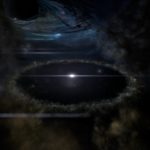
System Specs:
- Stellar Mass: _ Sol-masses
- Stellar Class: _
- Luminosity: _ Sol
- Planets: 5
- Moons: 0
- Asteroid Belts: 1
- Asteroids: 1
- Objects: 1
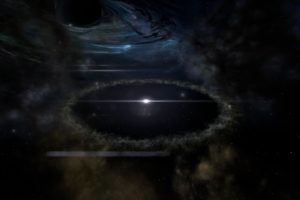
It provides a clear view of the Black Hole at the center of the Heleus Cluster.
The system is named after Ida Laura Pfeiffer, a 19th century Austrian traveler and author who was one of the first female explorers.
Asteroid
DATA:
- C type Asteroid
- Diameter: 492 km
- Surface Gravity: 0.025 G
ANALYSIS:
The unusual mineral composition of this asteroid suggests it may have origins outside the Pfeiffer system and became caught in the sun’s gravity.
–
Planets Directory:
- H-480
- Korvath
- Reyer
- H-479
- H-461
- Black Hole
–
H-480:
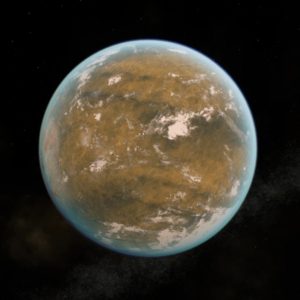
- Orbital Distance: 1.7 AU
- Orbital Period: 1.7 Earth-years
- Keplerian Ratio: 1.7
- Radius: 8,238 km
- Day Length: _ Earth-hours
- Atmospheric Pressure: 0.72 atm
- Surface Temp: 152 °C
- Surface Gravity: _ g
- Mass: _ Earth-masses
Thick dust clouds, dangerous electrical storms, and heavy gravity render H-480 inhospitable even for well-equipped krogan explorers.

–
Korvath:
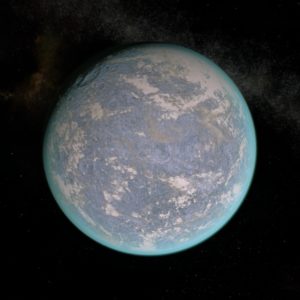
- Orbital Distance: 2.3 AU
- Orbital Period: 3.5 Earth-years
- Keplerian Ratio: 0.993
- Radius: 11,963 km
- Day Length: _ Earth-hours
- Atmospheric Pressure: 0.05 atm
- Surface Temp: -58 °C
- Surface Gravity: _ g
- Mass: _ Earth-masses
Thanks to Korvath’s thin atmosphere, its brutally cold deserts can reach extremely high temperatures in direct sunlight. Limit exploration to twilight hours only.

–
Reyer:
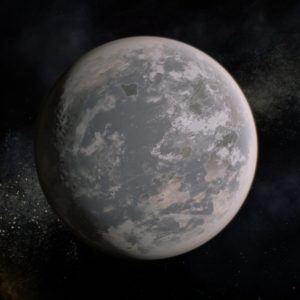
- Orbital Distance: 4.0 AU
- Orbital Period: 6.1 Earth-years
- Keplerian Ratio: 1.72
- Radius: 8,971 km
- Day Length: _ Earth-hours
- Atmospheric Pressure: 0.87 atm
- Surface Temp: 82 °C
- Surface Gravity: _ g
- Mass: _ Earth-masses
Though the planet is highly toxic to most known lifeforms, Reyer’s helium-rich atmosphere appears to host enormous colonies of fungal spores.
Escape Pod
DATA:
Identification: AI-055 Escape Pod
Assigned to: Ark Leusinia
Status: Damaged
Life support: Non-operational
ANALYSIS:
This escape pod from the asari ark appears to have drifted off-course and suffered micro-meteorite damage. Unfortunately, its logs are beyond recovery.
–
H-479:
- Orbital Distance: 9.7 AU
- Orbital Period: 30.4 Earth-years
- Keplerian Ratio: 0.988
- Radius: 6,843 km
- Day Length: _ Earth-hours
- Atmospheric Pressure: 3.21 atm
- Surface Temp: 117 °C
- Surface Gravity: _ g
- Mass: _ Earth-masses
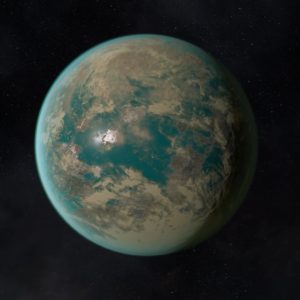
Extreme radioactivity and high-velocity winds make H-479 a poor candidate for mining, despite its rich metal deposits. A potential candidate for future endeavors.
–
H-461:
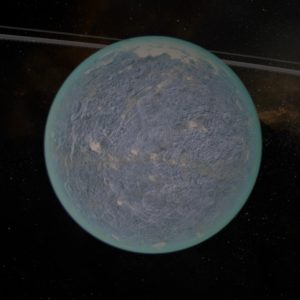
- Orbital Distance: 40.1 AU
- Orbital Period: 254.4 Earth-years
- Keplerian Ratio: 0.996
- Radius: 5,103 km
- Day Length: _ Earth-hours
- Atmospheric Pressure: 0.00 atm
- Surface Temp: -215 °C
- Surface Gravity: _ g
- Mass: _ Earth-masses
This outlying world is comprised of iron and frozen nitrogen. One oddity stands out: certain geological features suggest the nitrogen seas were once liquid.
–
Black Hole:
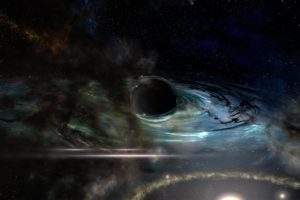
DATA:
Class: Kerr black hole, “H-012 Ketos”
ANALYSIS: Even at this distance, the black hole presents a risk to onboard ship systems. The accretion disk around it is composed of the remains of at least one solar system, destroyed by the black hole’s formation and gravitational pull.
Caution is advised.
Codex Entry

At the center of the Heleus Cluster is a black hole, a huge star that has collapsed into a region of space-time with gravitational effects so powerful that even light cannot escape. This example is believed to be a Kerr black hole approximately 12 stellar masses in size, and appears to have absorbed additional mass from nearby systems. Our scientists believe that the radiation released from the creation of the black hole may explain the abundant element zero found in Heleus.
In the Milky Way, study of black holes was still in its infancy. The forces around the event horizon typically destroy probes before they can transmit their data. This black hole presents a unique opportunity for study even at a remove.
The original asari surveys of Andromeda called the black hole Ardat Hekas, “demon’s maw.” Initiative charts refer to it as H-012 Ketos, after the mythological sea monster that intended to devour the princess Andromeda.
According to their scientific journals, angaran astronomers called the black hole Haranj (roughly: “the fisher’s lure”) for the observable effect it has on comets and surrounding systems. The gravitational lensing effect of the black hole has allowed the angara-controlled planet Aya to go largely unnoticed by the kett.
Continued observation has shown interesting interactions between the black hole and the Scourge. There is evidence that some of the Scourge’s mass is being drawn into the black hole, causing continued “currents” in the phenomenon. Our scientists have suggested that without the black hole, the Scourge phenomenon might have been even more hazardous.
–